



The Struggle for Democracy, and New Social Movements
Recent years have seen the emergence of new social movements focused on pressing for social and political changes in Latin American and Caribbean societies. Black and indigenous groups, feminists, environmentalists, labor unions, neighborhood associations, LGBTQ activists, and new political parties are endeavoring to change the socioeconomic landscape of the region. Some of the momentum for these movements came from the intellectuals and activists forced into exile by authoritarian regimes during the 1970s. The writings of these exiles brought worldwide attention to the conditions in their home countries. Other social movements have internal origins, such as the Mothers of the Plaza de Mayo in Argentina who organized to demand to know the fate of their sons and daughters who disappeared during the brutal dictatorship from 1976-83.
Feminist and women’s rights groups have been increasingly successful in agitating for greater representation in legislative and other leadership positions. Inspired by the Mothers of the Plaza de Mayo, many women across the region have adopted wearing distinct green scarves (now known as the Green Wave) as a symbol of their advocacy for women’s rights. Nicaragua, Panama, Haiti, Guyana, Dominica, and Jamaica were among the first countries to have female leaders of state. Since 2010, Argentina, Brazil, Chile, Costa Rica, and Trinidad and Tobago have all had women as presidents. Claudia Sheinbaum became the first female (and person of Jewish descent) elected president of Mexico in 2024.
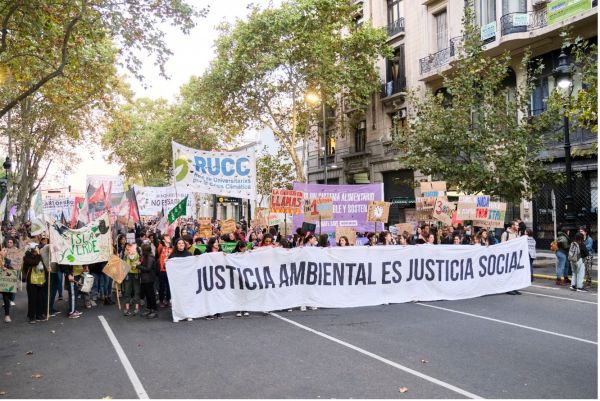
This march during an Earth Day demonstration in Buenos Aires, Argentina shows activists with a sign saying Environmental Justice is Social Justice. Photo by Carolina Jaramillo 2022.
Black and Indigenous rights movements became more influential in the late 20th century. Movements to fight for racial justice were created in many countries in the late 1970s, beginning an era of Afro-Latin social and political mobilization that continues to the present day. Indigenous movements also were energized in the 1980s by the shift to democracy in many countries. In Bolivia and Ecuador, countries with significant indigenous populations, these native groups formed their own political parties. Alejandro Toledo was a Quechua who served as president of Peru from 2001 to 2006. Evo Morales Ayma, an Aymara Indian, won the presidency of Bolivia in 2005 and was reelected in both 2009 and 2014.
New political parties and movements in Latin America are being created that offer promises to move beyond the existing status quo. Some of these movements are on the left of the political spectrum while others are on the right. One such example is that while Jair Bolsonaro was elected as President from a traditional party in 2018 in Brazil, he eventually left the party and governed outside the bounds of existing political structures. In Chile, Colombia, Costa Rica, and Mexico, candidates from newly formed political parties have won the presidency in the last several years. It remains to be seen whether these new parties and movements will bring fundamental changes.
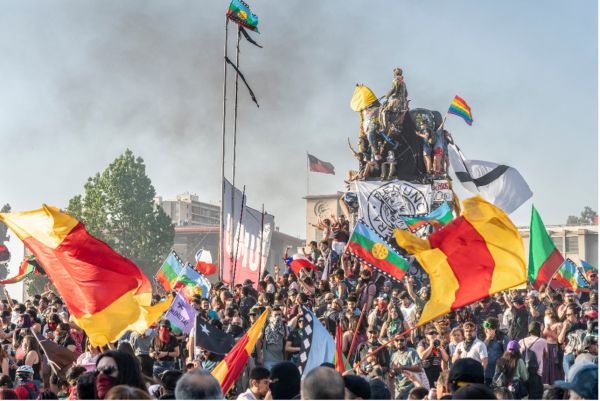
Chile is a democracy that has boasted one of the most vibrant economies in Latin America. Nevertheless, massive street demonstrations at the end of 2019 and early 2020 were held to express frustration that few of the benefits of economic growth were being shared by the masses. Photo by abriendomundo, 2019.
The struggle for increased human and environmental rights is not without costs. Since systematic tracking began in 2012 by the organization Global Witness, more than 2,250 environmental and land defenders have been killed or disappeared worldwide, with Latin America consistently accounting for most cases. In 2024, Colombia, Guatemala, Mexico, and Brazil were the countries with the most murders of environmental activists.