


The Mixing of Peoples
Demand for cheap labor during the colonial period led to the European powers turning to enslaved people from Africa to assist them in exploiting the riches of their North and South American colonies. The Portuguese brought the first slaves to Brazil in 1526, and it is estimated that in the 350+ years to follow, more than 12 million slaves were brought to the Americas. This was substantially greater than the estimated 1.9 million Spaniards and 800,000 Portuguese who moved to the colonies between 1500 and the 1820s.
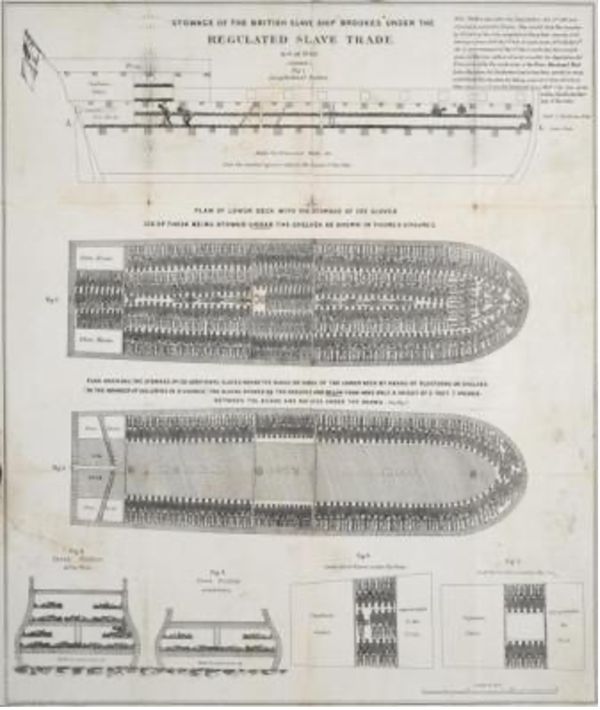
Africans were packed like animals in the slave ships that transported people to North and South America. This plan of the British slave ship Brookes is an example of how 454 slaves were accommodated in such a small space. The drawing was published originally by Society for Effecting the Abolition of the Slave Trade, a British abolitionist group formed on May 22, 1787. Library of Congress Rare Book and Special Collections Division, LOC LC-USZ62-44000, LC-USZ62-34160.
After the Conquest, the population of Latin America became a mix of indigenous people, slaves, and European colonizers. In different countries, a variety of names to categorize these various mixtures have developed. Examples include mestizo and ladino (a mix of European and Amerindian), zambo (a mix of Amerindian and African), and mulatto (a mix of European and African ancestry). More recently, people from East Asia, the Middle East, many other parts of Europe, and other origins have added to the mix of ethnic diversity.
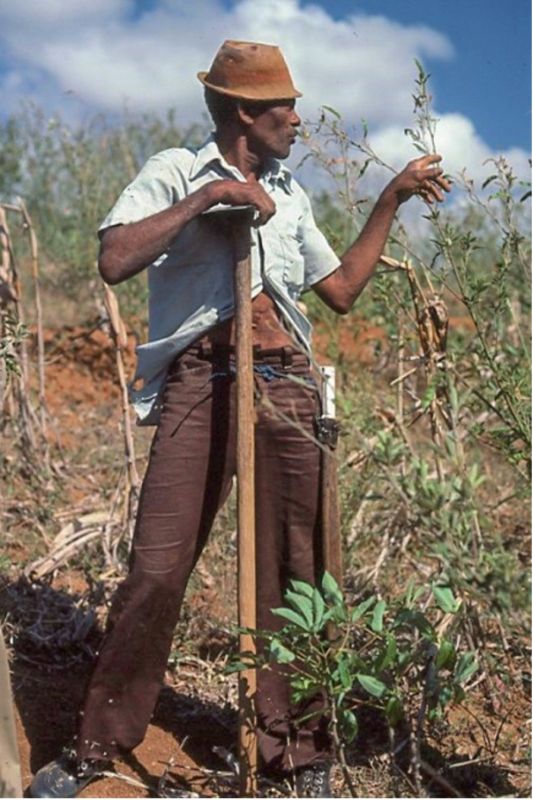
A farmer in the southwest part of the Dominican Republic tends to his pigeon peas, a crop that came to the Americas as part of the slave trade in the 17th century. Photo by Bill DeWalt, 1988.