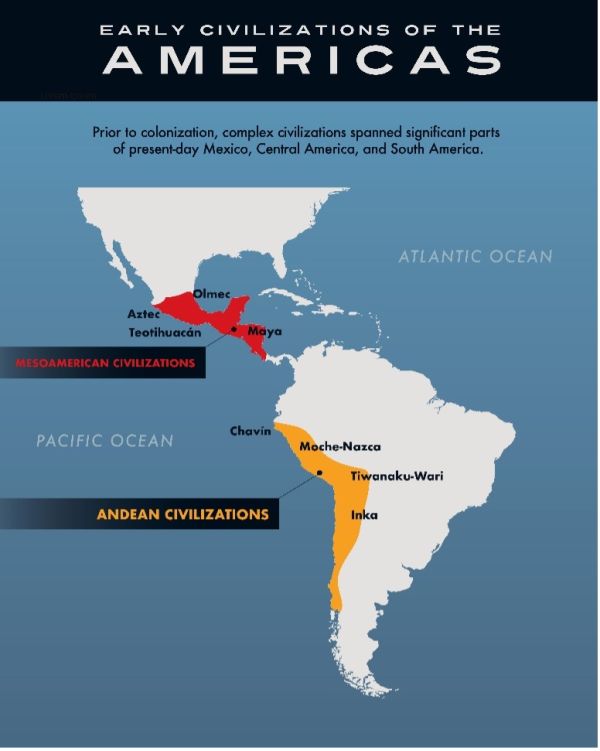



The Rise and Fall of Complex Civilizations
Approximately 5000 BCE the original settlers of the Americas began to construct more complex societies that were as impressive as any that existed in Asia, Europe, or Africa. On the Pacific Coast of Peru, remains of a complex society have been discovered that include as many as thirty major population centers with large scale public buildings and other structures. These sites, often referred to as the Norte Chico civilization, have been dated to between 5000 BCE and 2500 BCE. The major city of Caral and other nearby complexes are sited in an area that is virtually devoid of rain and prone to earthquakes. Nevertheless, by using irrigation from the rivers running from the Andes to the coast, the people built a complex civilization.
Fish and shellfish from the coast, squash, beans, sweet potatoes, and perhaps corn sustained a population estimated at 3,000 people at Caral. Cotton was an important commodity that was cultivated and seems to have been widely traded. Textiles have been found including knotted fibers (quipus) that may have been used as some sort of record-keeping system. To date, no evidence of pottery, sculpture, painting, or warfare has been found at Caral or nearby sites.
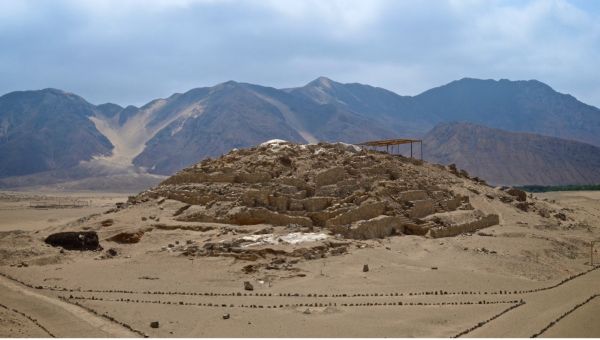
The stone pyramids at Caral were constructed in the same century as the earliest pyramids in Egypt. In contrast to the cut-stone construction in Egypt, the Caral pyramids were built with stone-filled bags stacked behind each successive retaining wall of the step pyramids. Photo by Mark Green.
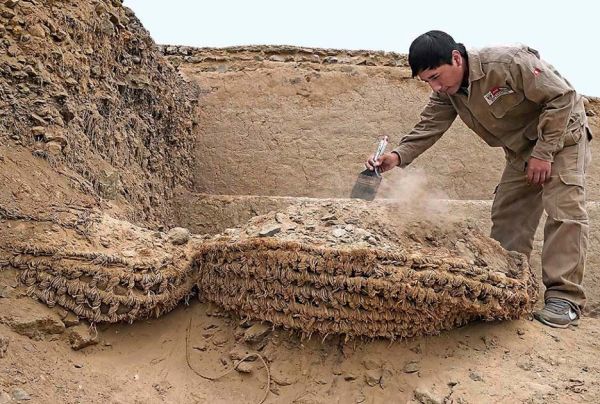
Stone-filled cotton bags called shikra were used to build the pyramids at Caral. Photo by Andina
By about 1200 years BCE, even more complex societies were being created in Mexico, Central America, and South America. These people built impressive cities with monumental architecture; made great advances in writing, mathematics, astronomy, agriculture, technology, and art; and eventually created states or empires that spanned large territories. Hundreds of impressive archaeological sites have been found in Mexico, Central America, and South America from many different cultural groups. These cultures occupied a diversity of ecological habitats from arid deserts to tropical rainforests, coastal plains to high mountains, and blistering heat to bitter cold. Warfare and conquest were frequent, and societies rose and fell in ways common to all parts of the world.
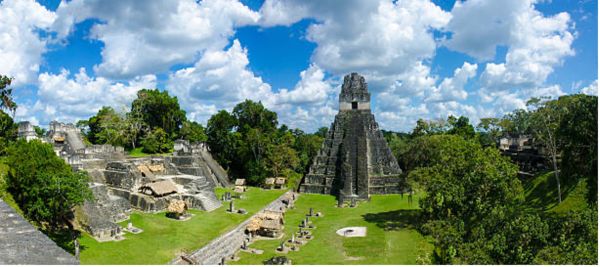
The Maya site of Tikal in Guatemala. Photo by SimonDannhauer.
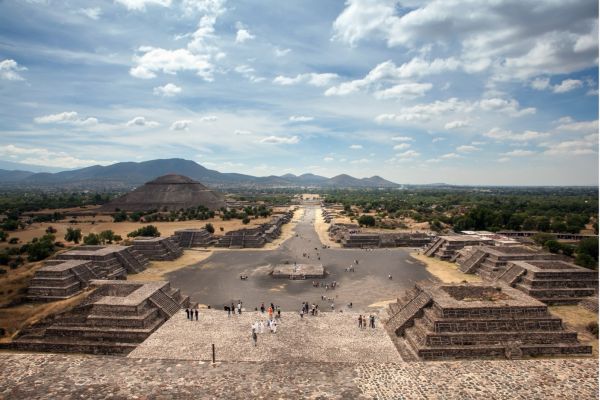
A view of some of the Avenue of the Dead and the Pyramid of the Sun at Teotihuacan in the highlands of central Mexico. Photo: Vladimir Korostyshevskiy
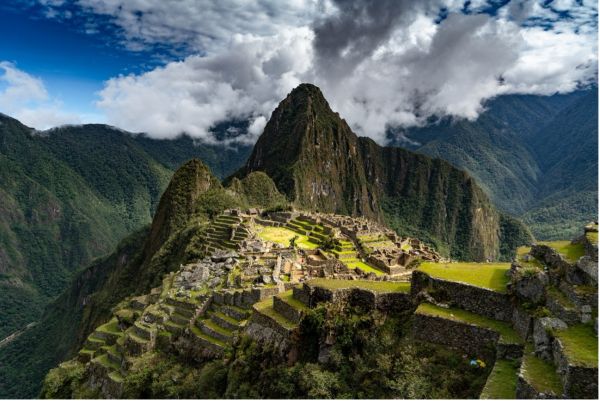 The Inca Site of Machu Picchu in Peru. Photo by DoraDalton.
When Europeans arrived on the shores of Latin America and the Caribbean, it is estimated that more than 50 million people lived in the region. The Aztecs controlled much of Mexico and Central America from their capital at Tenochtitlan. In South America, the Inka empire stretched 3,416 miles from what is now southern Colombia to central Chile. It is important to recognize that more than 1,000 different cultures and languages existed in Latin America before European colonization. Regrettably, many of these cultures and languages have disappeared forever, but substantial numbers of people in Latin America still speak one of the many indigenous languages that have survived.
Among the most well-known of the complex societies in the Americas were these:
Mexico and Central America South America
Olmec (1200-400 years BCE) Chavín (800-200 years BCE)
Teotihuacán (1-500 CE) Moche and Nazca (100-700 CE)
Maya (500 BCE-800 CE) Tiwanaku and Wari (600-1000 CE)
Aztec (1430-1521 CE) Inka (1250-1532 CE)
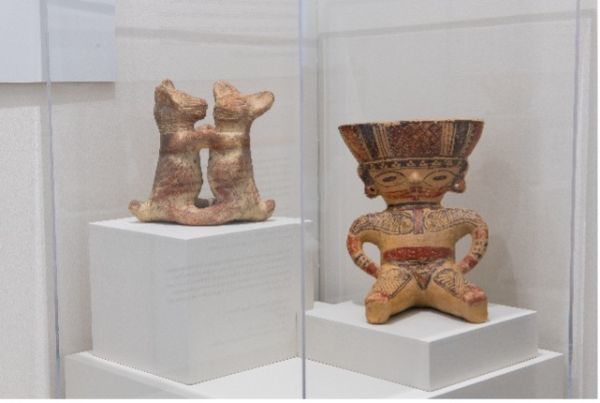
Dogs were among the few domesticated animals in the Americas prior to European colonization. Circa 2000 years ago, ceramic sculptures of these dogs began to be placed in burials, especially in what is now the state of Colima in western Mexico. Replicas of dancing dogs have become a symbol of the state and are widely sold in gift shops.
Dancing Dogs Replica
Unidentified Artist
Colima, Mexico 1984
Ceramic
Loan from collection of Sylvia Keller and Bill DeWalt
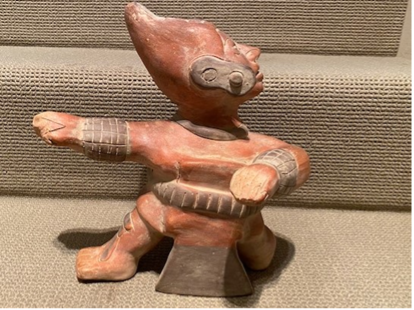
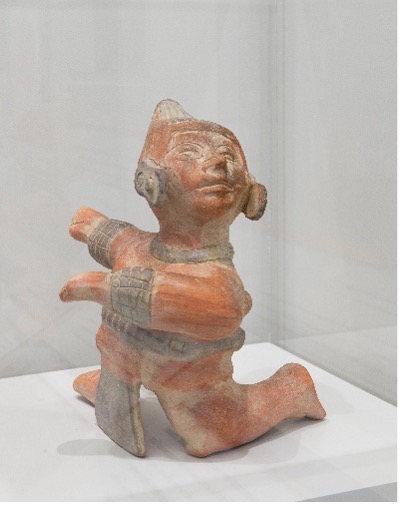
Ballplayers are often depicted with heavy padding for protection against the solid rubber balls that they used. Some sources suggest that losers in important games were ritually sacrificed.
Mexican Ballplayer Replica
Unidentified Artist
Teotihuacan, Mexico 1984
Ceramic
Loan from collection of Sylvia Keller and Bill DeWalt