



Latin Americans on the Move
Latin America was once an attractive destination for immigrants escaping religious discrimination, poverty, violence, and political instability especially in the 19th and early 20th centuries, but more recently has become one of the world’s major regions of emigration. Longstanding challenges of inequality, underdevelopment, and poverty have been exacerbated by a toxic mix of corruption, drug cartels, a proliferation of gangs, and increasing violence. Many people in Latin America and the Caribbean feel that to protect themselves and their families or to have better economic opportunities they must leave their homes.
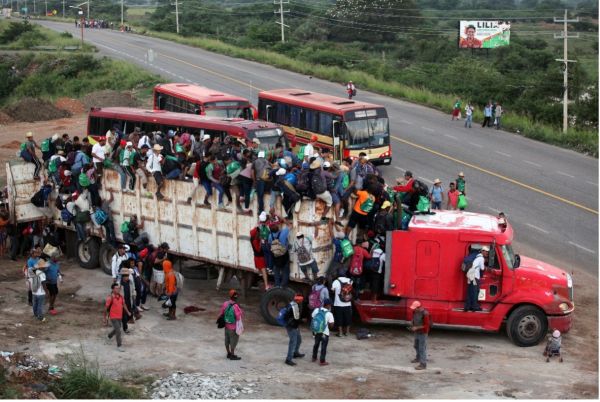
Hondurans fleeing poverty and gang violence climb aboard a truck in Santo Domingo Ingenio, Oaxaca, Mexico as part of a caravan seeking entry to the United States. Photo by Vic Hinterlang Nov. 8, 2018.
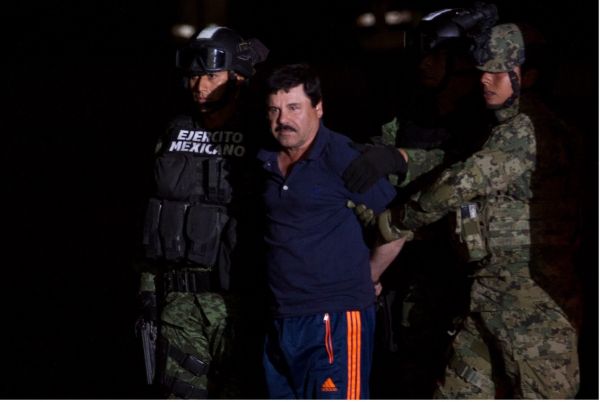
Joaquín Archivaldo Guzmán Loera was the leader of the Sinaloa Cartel, one of the most powerful Mexican drug cartels. Known as El Chapo (Shorty), here he is presented to the media in a hangar at the airport in Mexico City following his arrest in 2016. Photo by Octavio Hoyos January 8, 2016. (Extradited to the U.S. in 2017, he was found guilty of many criminal charges, sentenced to life imprisonment, and is incarcerated in a US federal prison.)
Criminal gangs, drug cartels, and violent crime are perhaps the most pressing problems affecting Latin America and the Caribbean today. Gangs in Haiti, El Salvador, Honduras, Guatemala, Brazil, and other countries control and terrorize significant parts of the population. Drug cartels and/or trafficking networks are prominent in Mexico, Colombia, Peru, Bolivia, Brazil, and Honduras and are growing in other countries, According to the Global Peace Index, more than 40 of the 50 most dangerous cities in the world are located in Latin America, with many countries having five to ten times higher murder rates than in the United States.
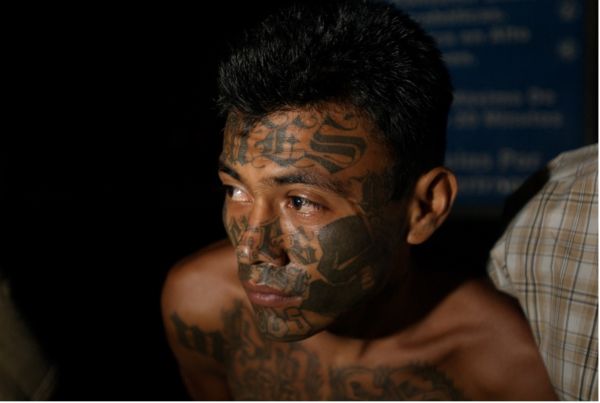
Mara Salvatrucha (MS 13) gang member captured in Soyapango, one of the most dangerous areas of El Salvador. Photo by ES James, 2008.
The United Nations estimates that more than 40 million Latin Americans live outside their country of birth, with the U.S. as the new home to about two-thirds of the region’s emigrants. Mexico was the origin of many of these people, but in recent years Hondurans, Salvadorans, Guatemalans, Haitians, and people from many other countries have become a much larger percentage of those seeking a new home in the United States. Substantial numbers of people have also been relocating to other Latin American countries. For example, it is estimated that the political and economic chaos in Venezuela after 2014 has led more than 7.7 million people (about 25% of the population) to leave the country with Colombia, Perú, Brazil, and Chile the principal destination for many of them.