



Contemporary Art
PAINTING
The art of Latin America is rich and varied, having origins in the pre-conquest civilizations, current indigenous cultures, African legacies, European influences, and other world contacts. From folk art that is continually evolving, to the massive murals that adorn buildings in many towns and cities, to the paintings and sculptures that reflect on culture and society, art is ubiquitous throughout the region and is increasingly recognized on a world scale. Superb museums in Latin America and around the globe bring this art to vast audiences.
Perhaps the most recognized Latin American modernist is Frida Kahlo (1907-1954) who frequently used herself as the subject of her paintings, often incorporating surrealist and fantastical elements. Some of her life was lived with Diego Rivera who, along with José Clemente Orozco and David Alfaro Siqueiros, was one of the three great Mexican muralist painters of the 20th century. Among other great artists, Tarsila do Amoral (Brazil), Fernando Botero (Colombia), Oswaldo Guayasamín (Ecuador), Guillermo Kuitca (Argentina), Wifredo Lam (Cuba), Matta (Chile), Ana Mendieta (Cuba), Juan Sanchez (Puerto Rico), Jesús Rafael Soto (Venezuela), Rufino Tamayo (Mexico), Joaquín Torres-Garcia (Uruguay), and Tunga (Brazil) are just a few of the many who merit mention.
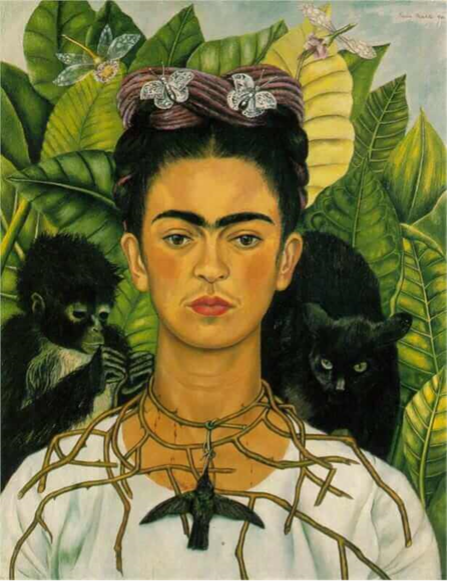
Self-Portrait with Thorn Necklace and Hummingbird (print)
Frida Kahlo
Mexico, 1940
Courtesy of the Nickolas Muray Collection, Harry Ransom Center, University of Texas at Austin
The Ecuadorian artist Oswaldo Guayasamín (1919-1999) was the son of an indigenous Quechua father and a mestizo (mixed) mother. His work Lágrimas de Sangre (Tears of Blood) was dedicated to the memory of three Chileans—President Salvador Allende, the musician Víctor Jara, and poet Pablo Neruda—who died at the time of the 1973 coup that created the Augusto Pinochet dictatorship.
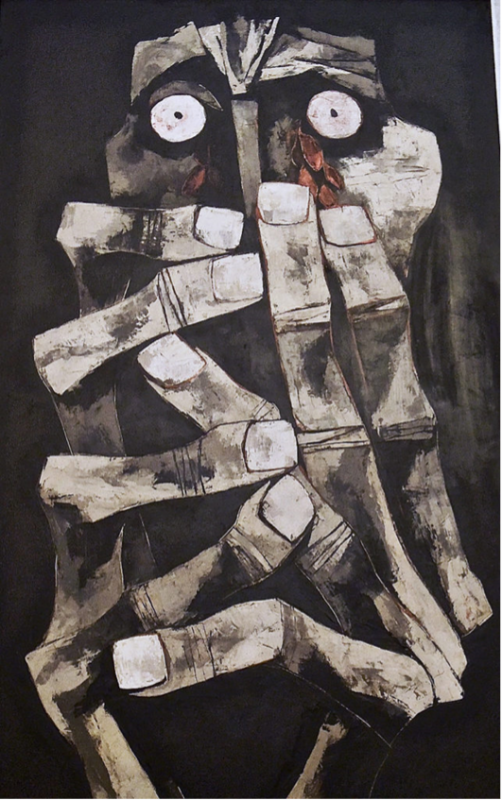
Lágrimas de Sangre (Tears of Blood)
Oswaldo Guayasamín
Quito, Ecuador, 1973
Painting Reproduction
Courtesy of the Fundación Guayasamín, Quito, Ecuador
PAINTING FEATURED IN OTHER AREAS OF THE MUSEUM
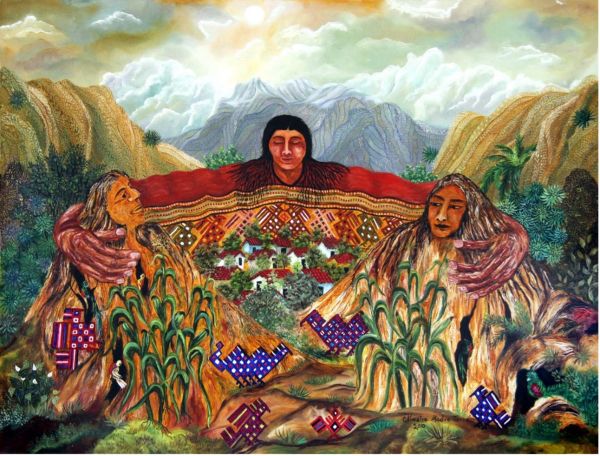
Our Mother Earth
Paula Nicho Cúmez
Kaqchikel Maya, San Juan Comalapa, b. 1956
Oil on canvas, 2010
Donation from the Helen Moran Collection
The Maya have a deep connection with Mother Earth and think of the Earth as sacred and as a living being. In this painting Paula Nicho Cúmez personifies Mother Earth, depicting her as a woman wearing the huipil (traditional blouse) of San Juan Comalapa, the Maya town where the artist has always lived. We see Mother Earth not only protecting the town, but also embracing the two nearby mountains that Paula personifies by giving them faces of wise old women. Painted on the two mountains are stylized birds, including the endangered quetzal, found on many Maya weavings.
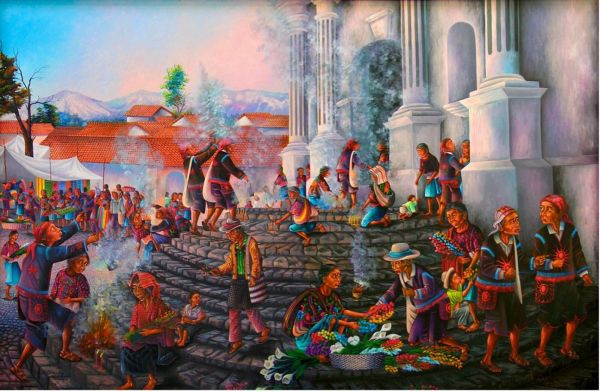
Day of Ceremonies in Chichicastenango
Pedro Rafaél González Chavajay
Tz’utujil Maya, San Pedro la Laguna, b.1956
Oil on canvas, 1997
Donation from the Arte Maya Collection
In the town of Chichicastenango, the steps outside the Church of Santo Tomás were built with stones from a Maya altar that previously occupied the site. There are twenty steps, one for each day of the Maya ceremonial calendar. Every day, Maya spiritual guides perform rituals on the steps, but these are not permitted inside the church proper. The ajq’ijab’ performing the ceremonies are day keepers, people who keep track of the Maya calendar and the significance of each day. These steps thus constitute an important line of demarcation—the most visible place in the Maya world where a mix of both Maya and Christian traditions are practiced.
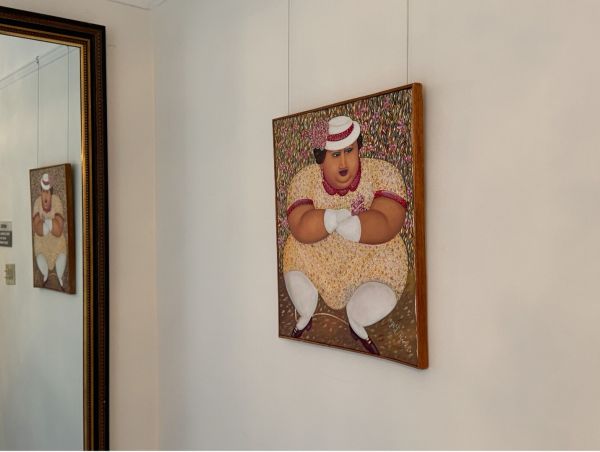
Figure from the Les Grosses Patates (Big Potatoes) Series
Pierre Louis Riche
Cap Haitien, Haiti b. 1954
Oil on Canvas, late 20th century
Donation by Stephanie Carleton
This painting belongs to the series Les Grosses Patates (“The Big Potatoes”) by Haitian artist Pierre Louis Riche, known for his stylized depictions of monumental human figures. Riche’s paintings combine playful exaggeration, richly patterned surfaces, and vibrant color to celebrate everyday life, costume, and personality within the broader traditions of Haitian popular painting. The rounded form, frontal pose, and decorative attire of the woman conveys both humor and dignity, while the densely textured background enhances the painting’s rhythmic visual energy.