



Empires Fall and Colonies Are Created
The arrival of explorers from Spain, Portugal, and other European powers beginning in the late 15th and early 16th centuries resulted in foreign domination of the peoples of the Americas. The Treaty of Tordesillas (1494, modified in 1506) divided the newly explored lands between Spain and Portugal, the dominant powers of the time. Later, Britain, the Netherlands, and France ignored this agreement and established colonies of their own, imposing their rule over the indigenous populations. Cities and existing social institutions were destroyed. European religions were imposed. Communities were enslaved and/or resettled to make social control easier. The early colonizers were initially interested in plundering silver and gold, but eventually also turned their sights to agriculture and other means of amassing wealth.
Conquest and colonization were brutal and cruel, leading to as much as a 90% decline in the indigenous population of the Americas. Diseases such as smallpox, measles, typhus, and influenza were introduced into vulnerable populations and, as a result, many indigenous cultures and their languages sadly disappeared.
The Aztecs and Inka had far greater numbers of fighters than the conquerors, but the Spanish had steel swords, muskets, cannons, horses, and superior military organization. Perhaps most importantly, the Spanish were also able to exploit internal divisions within the Aztec and Inka empires. Alliances with indigenous groups opposed to these empires greatly aided the conquest.
Cavalry forces were key to the Spanish conquest, and helmets like this one were used by the cavalrymen. Although the Morion helmet is often associated with the conquest of the Aztecs and Inka, it came into use a bit later in the 16th century and was used by explorers like Hernando de Soto and Coronado.
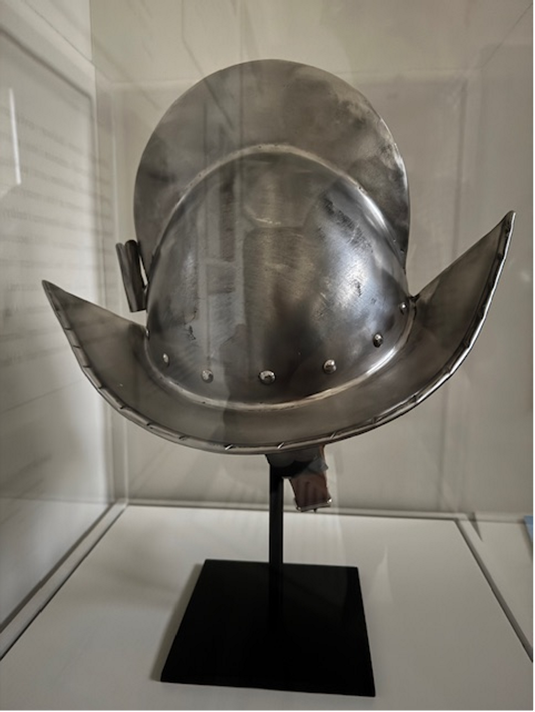
Morion (morrión) Helmet Replica
Unknown Maker
Italian
Metal and leather
Latin American Cultural Center purchase from Avalon Shop 2021
The Spanish and Portuguese worked closely with the monks and friars of the Catholic Church to use religion as one of the tools to conquer and subjugate the people of Latin America and the Caribbean. Clerics accompanied the early expeditions of Cortés, Pizarro, and other Spanish conquerors. They helped to tear down the temples and shrines to what they considered as “pagan” idols and imposed Christianity on the native populations.
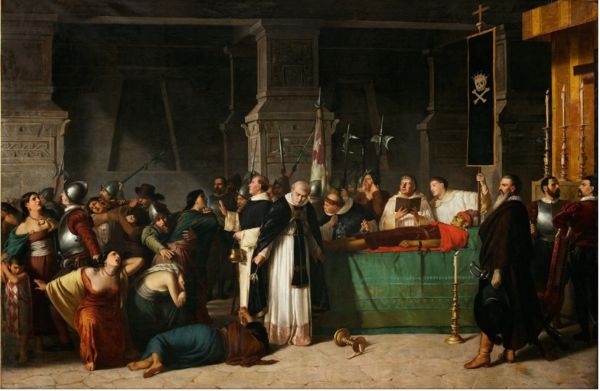
The Funerals of Inca Atahualpa by Luis Montero marked the beginning of Peruvian historical painting. The 1867 painting depicts the death of Atahualpa, the ruler of the Inka Empire. Facing his death from Spanish conquerors, he agreed to accept baptism to avoid being burned at the stake and was baptized as Francisco. Photo of painting from the collection of Pinacoteca Municipal Ignacio Merino in Lima, Peru.
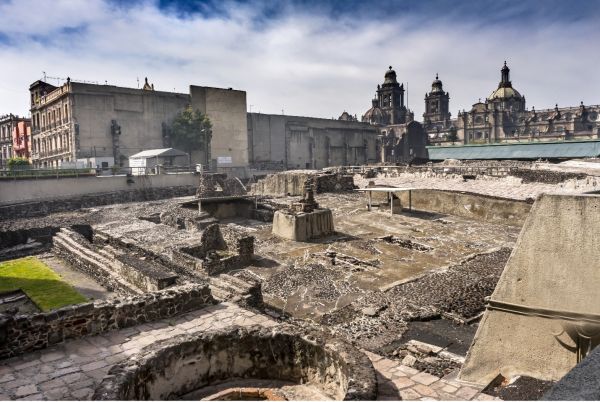
Part of the remains of the Aztec Templo Mayor are found just steps from the Metropolitan Cathedral in Mexico City. When the Aztecs were conquered, the temple was destroyed, and the cathedral was built on top of it to demonstrate the dominance of Christianity. Photo by B.P. Perry, 2019.
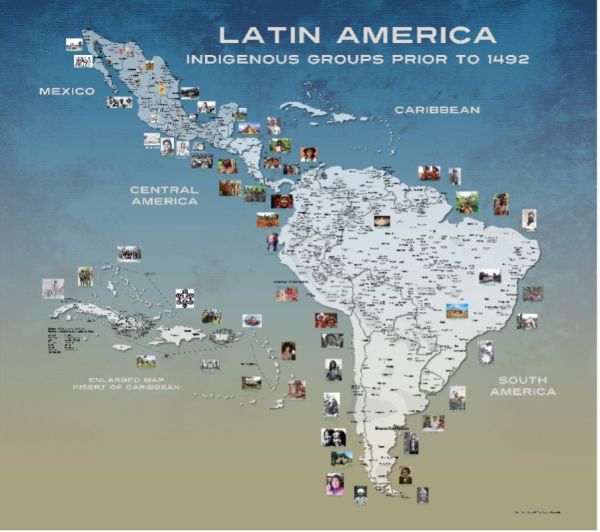
According to the World Bank, today approximately 42 million indigenous people live in Latin America, comprising 8% of the population. The indigenous population of this region currently speaks 560 distinct languages! In Brazil alone, 186 of those languages are spoken primarily in small, isolated communities in the Amazon. The largest remaining concentrations of indigenous people are in Bolivia (41% of the population), Guatemala (41%), Peru (26%), Mexico (15%), and Panama (12%). The most numerous indigenous groups include Aymara and Quechua (Bolivia, Ecuador, and Peru), Mapuche (Chile and Argentina), Maya (Mexico, Guatemala, and Belize), Guarani (Paraguay), and Nahuas, Zapotec, Mixtec, and Otomi (Mexico).