



Economic Uses of Natural Resources
The economy of Latin America and the Caribbean is very much linked to its wealth of natural resources. The region contains approximately 25% of the Earth’s forests and arable land, as well as more than 30% of the world’s water resources. The early colonists turned to the plentiful water and land resources and, utilizing slave labor, developed sugar cane plantations—especially on Caribbean islands and along the Atlantic coastal plains. Over time, a variety of other agricultural and livestock commodities gained prominence, including wheat, coffee, rubber, cattle, soybeans, and many others.
Sugar cane originated in the Canary Islands, was brought to the Americas by Christopher Columbus in 1493, and became the most important crop in many areas of Latin America during the colonial period.Slaves provided the huge amounts of labor needed to cultivate this crop on the plantations. Brazil is still the largest producer of sugar cane in the world, although now its cultivation is largely mechanized.
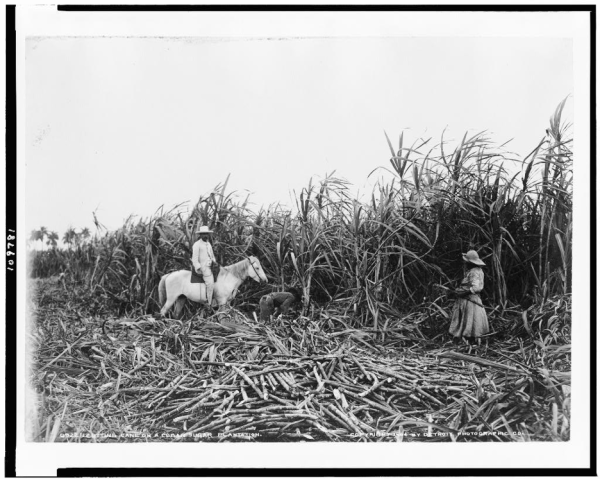
Cubans are cutting cane on a sugar plantation in this photograph from circa 1904. Photo from the Library of Congress, Item 94504519.
European conquerors were initially drawn to Latin America because of the mineral riches it held, principally gold and silver. The region is also rich in iron, copper, aluminum ore (bauxite), tin, lead, nickel, and other minerals, making it among the world’s leaders in mining. More recently oil, natural gas, coal, uranium, and lithium have become important commodities in the region.
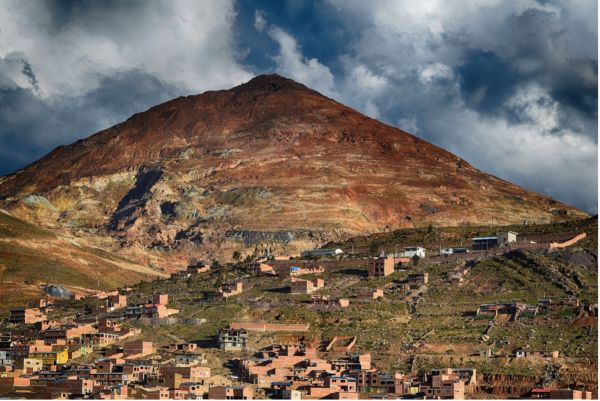
Cerro Rico is a mountain in the Andes near the Bolivian city of Potosí. Following the discovery of silver there in 1545, some estimate that 85% of silver produced in the central Andes came from mines in this mountain. It is also known as the “mountain that eats men” because of the huge number of miners who perished extracting the riches within. Photo by Matthias Kestel, 2019.
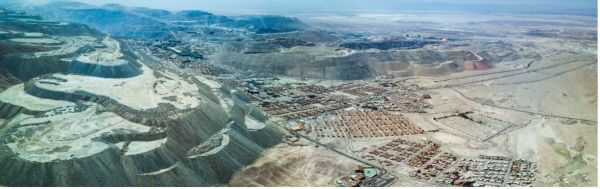
Chuquicamata, the world’s largest open pit copper mine at Calama, Chile, is one of the reasons why copper is the country’s largest export. Since colonial times, copper has been mined in the area between central Chile and southern Peru, but it was only in the 20th century that it became more important than other mining exports such as saltpeter or silver.
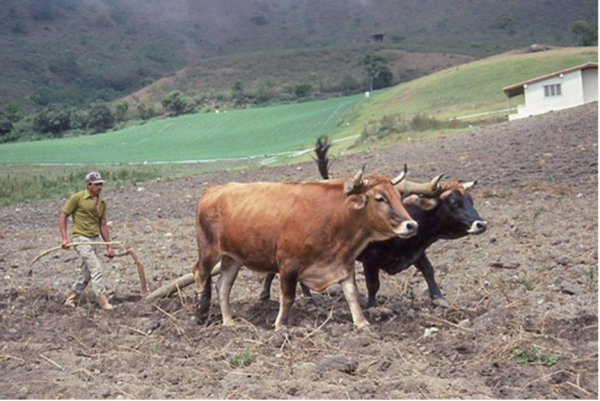
Latin America has large numbers of small farm owners, some of whom still use animal-drawn plows to plant crops, such as in this area near Bailadores, Venezuela. Photo by Bill DeWalt, 1991.