


Latin Americans of Today
Latin America is the fourth most populous region in the world (after Asia, Africa, and Europe) with approximately 8.1% of the world’s population. It is still relatively sparsely populated with a density of 33 people per square kilometer, much smaller than Asia’s population density of 156 per square kilometer.
The fertility rate has declined dramatically in the past several decades and now, with an average of 1.8 live births per woman, it is lower than in all other world regions except Europe and Northern America. Life expectancy at birth has been increasing and in 2026 averaged 73 years for males and 79 for females.

A group of girls in Latin America. Photo by Daniel M Ernst
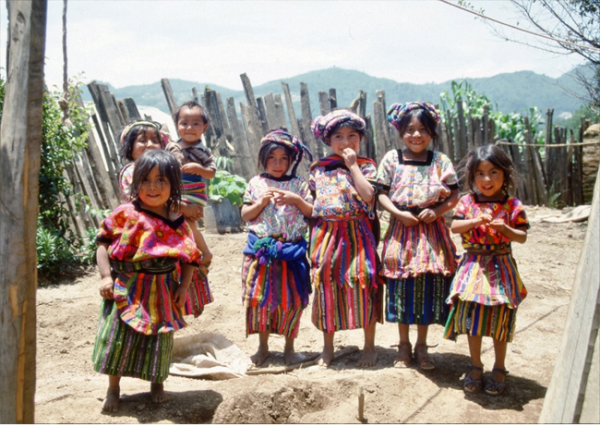
Little girls and one of their brothers pose in the yard of a village in the highlands of Guatemala. Photo by Bill DeWalt, 1988.
The natural barriers in Latin America that created such extensive biodiversity have also resulted in the proliferation of many political entities. Although many political dreamers have sought to create greater unity among the societies of the region, this has proved immensely difficult. Latin America today is composed of 33 separate countries ranging from tiny St. Kitts and Nevis (with just over 50,000 people) to Brazil, the sixth most populous country in the world (with more than 200 million people). In addition to the independent countries, 15 other former colonial dependencies in the region have varying degrees of autonomy in governance.
Latin America is now the most urbanized region of the world. In 1950, only about 40% of the population lived in urban areas, but now approximately 81% of people live in cities and towns. The world average is approximately 56%. Of the world’s largest cities, São Paulo now ranks 6th (at nearly 23 million people), Mexico City is 7th, Buenos Aires is 17th, and Rio de Janeiro is 23rd in size.
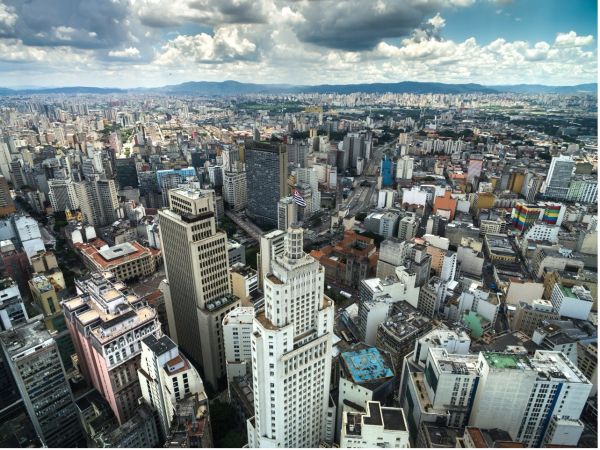
São Paulo, Brazil is a heavily urbanized area that is the sixth largest city in the world. Photo by unknown.
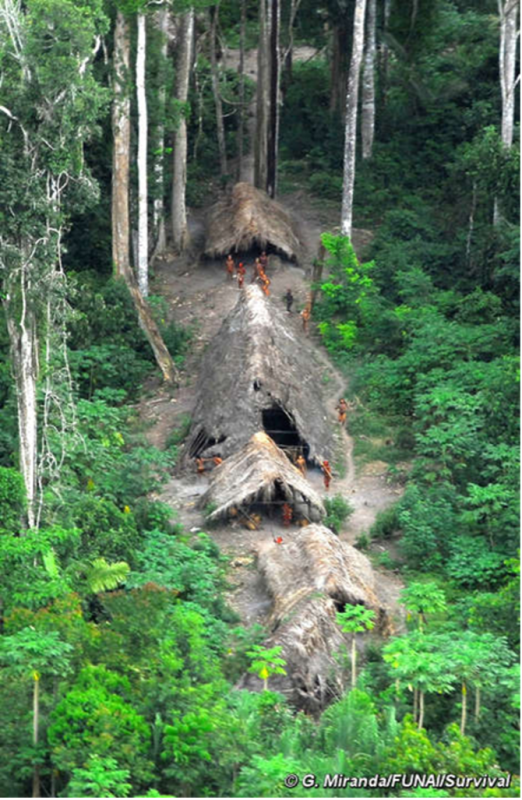
Groups of uncontacted indigenous people still inhabit parts of the Brazilian Amazon, but they are under increasing threat from illegal logging, cattle ranching, and introduced diseases. When an aircraft flew over their village, this group felt threatened and drew their weapons to defend themselves. Photo by G. Miranda FUNAI/Survival, 2008.