



Humans Reach the Americas
Archaeological research and DNA evidence suggest that the first people to settle in the Americas were hunters and gatherers from northeast Asia who crossed into northwest North America as many as 20,000 years ago. Although Beringia, the area between Siberia and Alaska, is now covered by a sea, during the Ice Ages a land bridge allowed people to walk and/or use small boats to migrate into North America. The exact dating of this migration is constantly being debated and revised by scholars as new evidence is discovered.
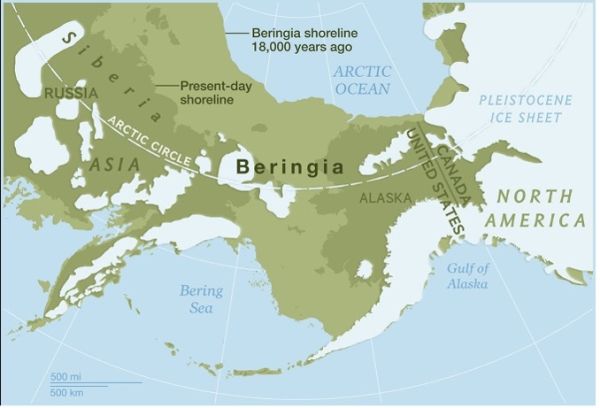
A land bridge connected the coastal area between northeast Asia and northwest North America approximately 20,000 years ago. Map courtesy of National Geographic Map Department.
Within a few thousand years, people had spread into almost all parts of North, Central, and South America. Some groups probably traveled by boat navigating along the Pacific Coast, but others ventured farther inland on foot. Many early settlements have undoubtedly been covered by higher sea levels, but a growing number of ancient coastal sites from British Columbia to as far south as Monteverde, Chile have been explored in recent years. Some of these settlements date as far back as 15,000 years ago.
The Coastal Connection
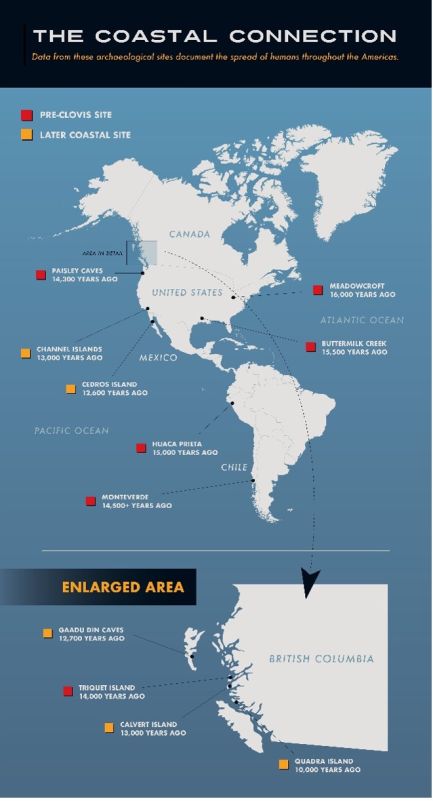
Data from these archaeological sites document the spread of humans throughout the Americas
Around 11,000 years ago, extensive changes occurred in the climate as the Ice Age ended. Climate change combined with human hunting, caused many species to disappear and people began relying on gathering of wild grains, fruits, and vegetables. Like the process in the Old World, people eventually began planting and cultivating these crops and raising animals--a process known as domestication. Unlike in the Old World, few animals were part of this domestication process.
TIMELINE 20,000-1,000 BCE
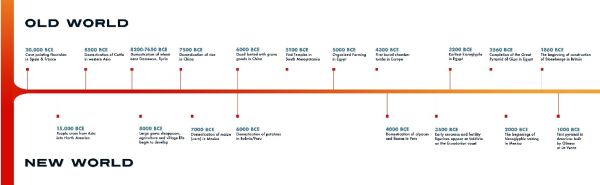
This TimeLine shows a comparison of major events in the Old World (Europe, Africa, and Asia) with those in North and South America. The notation CE refers to the Common Era, which begins in the Gregorian calendar year 1. This is the most used system throughout the world. For example, the year 2025 is 2025 CE. The notation BCE refers to Before the Common Era so a date of 5000 BCE is more than 7025 years ago.
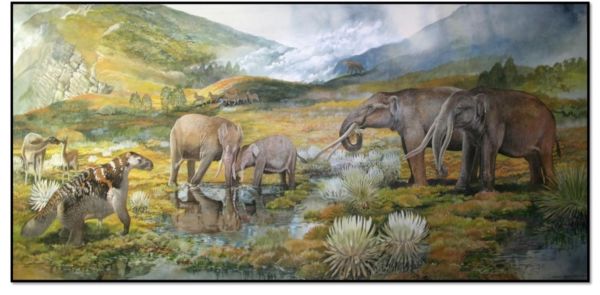
This illustration depicts a South American Pleistocene (a period that began about 2.6 million years ago and lasted until about 11,700 years ago) landscape with a diversity of mammals including Andean gomphothere, giant ground sloth, long-legged llama, glyptodont, horse, and giant ground sloth. Illustration by Peter Schouten.
When humans first arrived in the Americas, they encountered giant armadillos, mastodons, mammoths, muskox, camels, saber-toothed cats, and many other animals that eventually became extinct. Human hunting was probably a major factor in the disappearance of as many as 30 species of mammals.
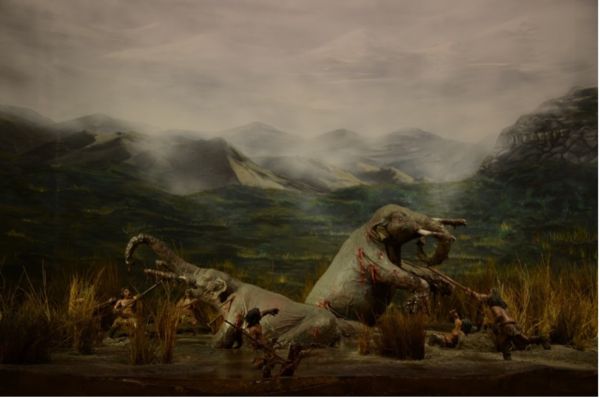
A diorama at the National Museum of Natural History in Santiago, Chile shows hunters killing mastodons. The evidence for this scene comes from excavations of a site at San Vicente Tagua Tagua, Chile, dating from more than 9,000 BCE. Photo by Richard Faundez. Image used by permission of the Museo Nacional de Historia Natural, Santiago, Chile.
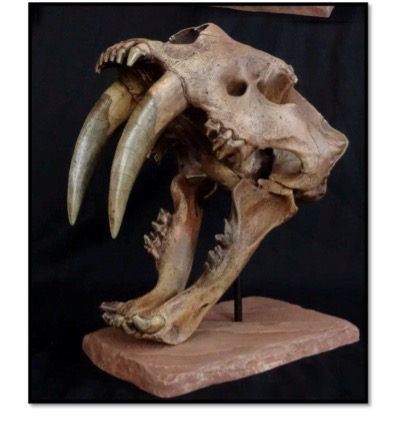
Saber-toothed cat
Smilodon populator
Cast of fossil skull
Uruguay
Pleistocene—earliest Holocene (2,580,000-10,000 BCE)
Fossil cast
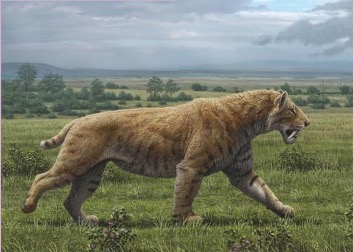
Saber Tooth Cat Illustration by Mauricio Anton
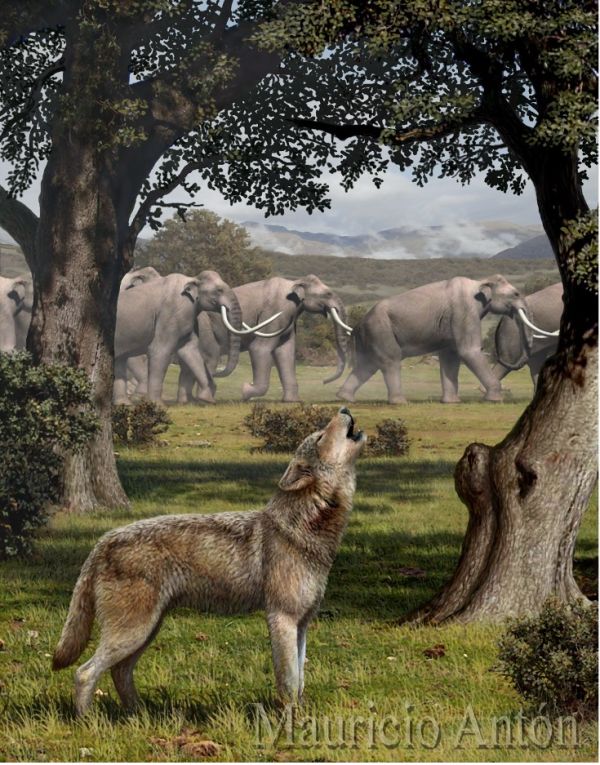
Dire Wolf. Illustration by Mauricio Anton