


Conflict
Latin American countries have played only a minor role in the major international conflicts over the past 125 years, and hostilities among the countries in the region have been limited. No Latin American countries fought in World War I. Late in World War II, Mexico sent fighter planes to the Philippines and Brazil sent troops to fight in Italy. Mexico sent about 100,000 troops to fight in the Korean War. Latin American countries did not participate militarily in either the wars in Iraq or Afghanistan. Argentina did fight the brief Falkland Islands War (known in Argentina as the Guerra Malvinas) against Great Britain in 1982 but were humiliated in attempting to claim sovereignty over the islands.
The most serious war between Latin American countries was a border dispute known as the Chaco War between Bolivia and Paraguay (1932-35). Border clashes between Peru and Colombia in 1932, and between Peru and Ecuador (1941, 1981, 1995) have also occurred. Some territorial disputes remain. Perhaps the most serious is that Venezuela claims a large portion of Guyana, now more serious because of recent major oil discoveries in Guyana. Guatemala claims more than half the territory of Belize. Bolivia lost its access to the Pacific to Chile in a 18th century war and would like to recover it. Unresolved contested boundaries exist between Ecuador and Peru, Argentina and Chile, Brazil and Uruguay, and Brazil and Bolivia. Some scholars have opined that there were too many conflicts within Latin American countries for them to have enough energy to fight one another or participate in global wars.
Underdevelopment and inequality in Latin America have been among the reasons why revolutions, military dictatorships, and civil wars have been recurring themes in the history of the region. Among many other conflicts, the Mexican Revolution that lasted from 1910 to 1920 was a major civil war caused by a rebellion against a dictator. A brief civil war in Costa Rica in 1948 led to the country abolishing its armed forces. The Guatemalan Civil War (1960-96) pitted the military against many leftist groups and caused an estimated 200,000 deaths. The Colombian Civil War that began in 1964 continues to this day despite a major peace accord that was signed in 2016. The civil war in Nicaragua lasted from 1979 to 1991. Dictators in many Latin American and Caribbean countries have used horrendous repressive measures against internal dissent, practices that continue to this day in several countries.
Despite the violence and conflict that has been pervasive in Latin America, the region has also produced notable peacemakers. One indication of this is the eight individuals from the region who have won the Nobel Peace Prize.
Argentina’s Carlos Saavedra Lamas (1936) was recognized for his work in mediating an end to the Chaco War between Paraguay and Bolivia.
Argentine painter, writer, and sculptor Adolfo Pérez Esquivel (1980) was honored for his opposition to Argentina's last civil-military dictatorship.
Mexican diplomat Alfonso García Robles (1982) was the driving force behind the Treaty of Tlatelolco, setting up a nuclear-free zone in Latin America and the Caribbean.
Costa Rican Oscar Arias Sánchez (1987), President from 1986 to 1990 helped to end the civil wars in Central America.
Guatemalan indigenous feminist Rigoberta Menchú Tum (1992) was recognized for fighting for the rights of Guatemala's Indigenous peoples during and after the Guatemalan Civil War.
Colombia’s Juan Manuel Santos Calderón (2016), President of Colombia from 2010 to 2018, negotiated a peace treaty with guerrillas that has nearly ended the civil war in the country.
Venezuelan opposition leader María Corina Machado (2025) won for her work promoting democratic rights for the people of Venezuela.
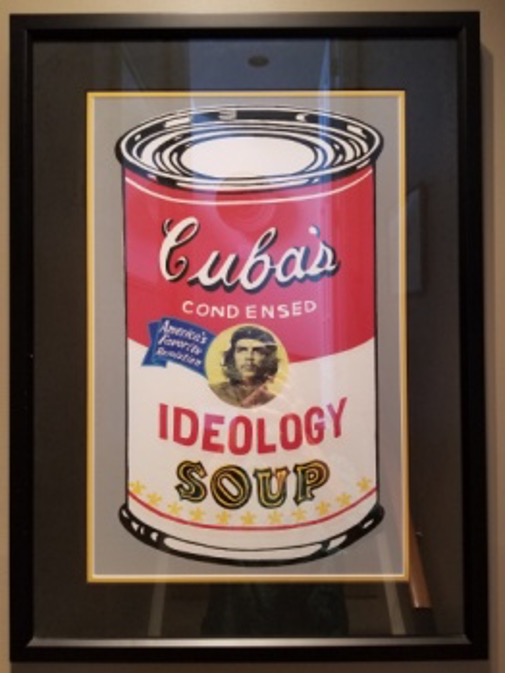
An artist in Cuba adapted an Andy Warhol painting of a Campbell’s Soup can. Portrayed on the can is Che Guevara, one of the heroes of the Revolution that brought Fidel Castro to power in 1959.
Cuba’s Ideology Soup
Unknown Artist
Havana, Cuba 1999
Print
Loan from collection of Sylvia Keller and Bill DeWalt