


Educating the Next Generation
Increased access to education has been one of the most important advances of the past several decades in Latin America. Primary school is compulsory in all countries, and the first stage of secondary education is compulsory in all countries except Nicaragua. The average adult literacy rate in the region is now about 95%, about seven percentage points higher than the worldwide average. Estimates are that as many as 23 million children between the ages of 4 and 17 (primarily from indigenous, Afro-descendant, or extremely impoverished populations) are not in the formal education system.
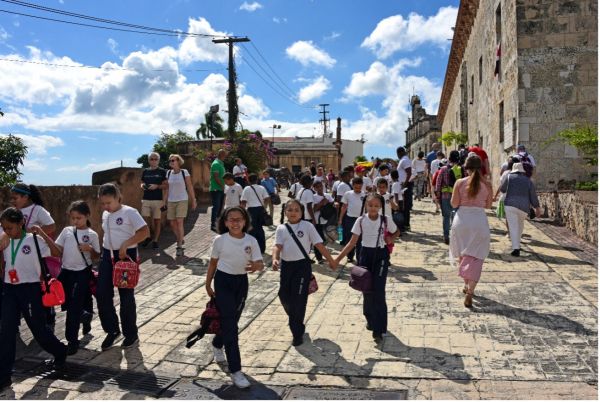
School children mingle with tourists in the historic colonial area of Santo Domingo, Dominican Republic, the oldest permanent European settlement in the Americas. As in most countries of Latin America, students wear uniforms to school. Photo by Paul McKinnon, 2019.
At one time, higher education was primarily provided by government-funded institutions or the Catholic church, but the number of private colleges and universities has grown substantially in recent decades to now number more than 3,000. The most robust institutions are in Brazil, Mexico, and Argentina, which together have nearly 60% of students enrolled in higher education.
A recent ranking of the top universities in Latin America shows the influence of the educational systems in the larger, economically dominant countries. Three of these are in Brazil: Universidade de São Paulo, Universidade Estadual de Campinas, and the Universidade Federal do Rio de Janeiro. Two are in Chile: Pontificia Universidad Católica de Chile and the Universidad de Chile. Two are in Colombia: Universidad de los Andes and Universidad Nacional de Colombia. Two are in Mexico: Tecnológico de Monterrey and Universidad Nacional Autónoma de México. One is in Argentina: Universidad de Buenos Aires.
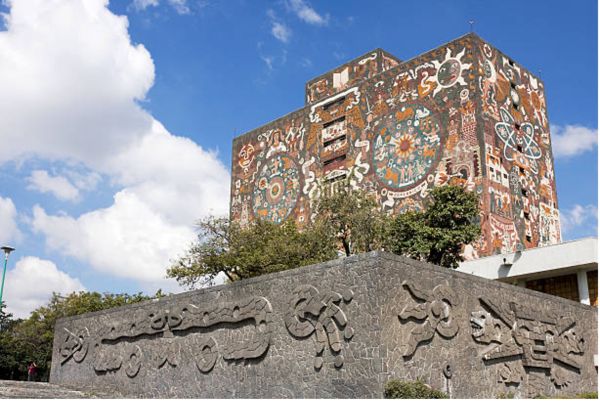
The main library at the Universidad Nacional Autonoma de Mexico is covered with the murals of Juan O’Gorman. Photo by abalcazar.
Six Latin Americans have won a Nobel Prize for their scientific contributions. Winners for contributions in Chemistry were Argentine Luis Federico Leloir in 1970 and Mexican Mario José Molina-Pasquel Henríquez in 1995. Nobel Prizes for Physiology or Medicine were awarded to Argentine Bernardo Alberto Houssay in 1947, to Brazilian Peter Medawar in 1960, to Venezuelan Baruj Benacerraf in 1980, and to Argentine César Milstein in 1984.